
1. Project Background
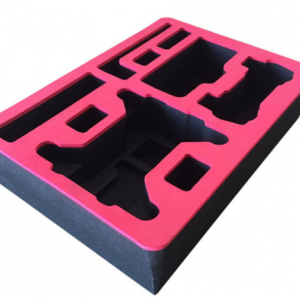
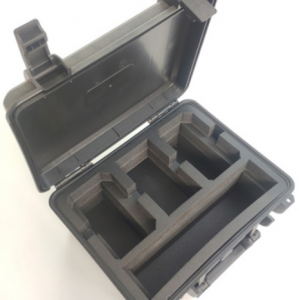
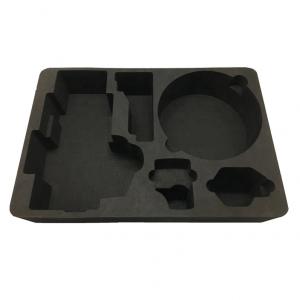
In early 2025, Yufa Polymer received an inquiry from a marine engineering company based in Asia. The client specializes in the development and manufacturing of Autonomous Underwater Vehicles (AUVs), with products widely used in offshore energy inspection, coastal infrastructure survey, and defense applications. The client required a cable reel base (Base Foam) for their flagship AUV product — a critical internal component used to secure and protect the cable management system, ensuring stable AUV operation in complex underwater environments.
Due to the client’s extremely high requirements for dimensional accuracy, surface quality, and batch consistency, this project placed severe demands on the supplier’s material understanding and CNC machining capabilities.
2. Project Details
|
Item |
Details |
|
Part Name |
Base Foam (Cable Reel Base) |
|
Project |
Autonomous Underwater Vehicle |
|
Material |
Standard EVA Foam |
|
Color |
Black |
|
Hardness |
Shore C 38° |
|
Dimensions |
Approx. 830mm × 470mm |
|
Machining Process |
CNC Precision Machining |
|
Machining Tolerance |
±0.1mm |
|
Client Location |
Asia |
3. Technical Challenges & Solutions
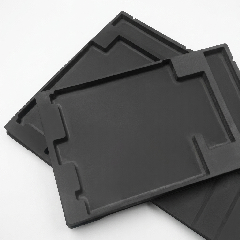
The part design fully reflects the marine engineering equipment’s pursuit of lightweight construction and maximum space utilization, but also presented multiple CNC machining challenges:
|
Challenge |
Solution |
|
Large-Size Machining |
The part measures 830mm × 470mm, classified as a large-size foam component. Large parts are prone to dimensional deviation during CNC machining due to extended tool paths, requiring precise tool compensation and multiple verification cycles. |
|
Curved Top & Bottom Surfaces |
Both the top and bottom surfaces feature curved profiles rather than flat planes. Curved surface machining requires multi-axis coordination, complex tool path planning, and strict control of surface consistency and finish. |
|
Rounded/Beveled Corners |
All four corners incorporate rounded fillets or beveled cuts, increasing the difficulty of tool selection and path programming. Each corner requires individual programming, with consistency across all four corners being critical. |
|
Extended Machining Time |
Due to the complex geometric features above, single-part CNC machining time is significantly longer than for conventional flat or simple-shape parts, placing higher demands on machine stability and tool life. |
|
Hardness Matching |
Shore C 38° is a medium-soft hardness. The material is prone to elastic deformation during machining, requiring specialized clamping solutions to maintain machining accuracy. |
4. Why EVA Foam? — Precise Matching of Material Properties to Application Requirements
As we detailed in our technical blog “EVA Foam CNC Precision Machining: From Material Properties to Three High-End Applications,” EVA foam offers irreplaceable advantages in marine engineering. This project is a vivid demonstration of those principles:
1. Lightweight Requirement → EVA Low-Density Property
AUVs are extremely weight-sensitive; every gram of reduction directly impacts range and effective payload. EVA foam density is only 1/6 to 1/40 that of rubber, minimizing part weight while providing sufficient structural support. The Shore C 38° hardness selection achieves the optimal balance between cushioning performance and structural rigidity.
2. Seawater Environment Resistance → EVA Closed-Cell Structure
AUVs operate in seawater environments long-term, requiring materials with excellent water resistance and corrosion resistance. EVA foam’s closed-cell structure has extremely low water absorption (≤0.05 g/cm²) and can be used in seawater environments long-term without performance degradation — perfectly matching marine engineering application requirements.
3. Complex Shape Requirement → CNC Precision Machining
The part’s curved surface and beveled corner design maximizes utilization of the AUV’s limited internal space while ensuring tight fit with surrounding components. CNC machining’s ±0.1mm precision ensures every part installs perfectly without secondary finishing.
5. Project Results
• First batch of samples successfully delivered, all dimensional accuracy meeting ±0.1mm requirements, client passed validation on first attempt
• Four corners showed excellent consistency in roundness and beveling
• Client expressed high recognition of machining quality and delivery time, long-term supply agreement signed
6. Project Value & Client Benefits
Value to Client
• Resolved supply chain bottleneck: The client had previously been unable to find a supplier meeting their technical requirements. Yufa Polymer successfully filled this gap with our extensive complex-curve machining experience.
• Reduced total cost: Although individual part machining time was longer, we effectively controlled machining costs through optimized tool paths and clamping solutions, keeping the client’s total procurement cost below expectations.
• Enhanced product reliability: High-precision EVA foam bases ensured stable cable management system fixation, improving AUV operational reliability in complex underwater environments.
Significance for Yufa Polymer
This project once again validates the application value of EVA foam in marine engineering and demonstrates Yufa Polymer’s technical capabilities in large-size, complex-curve CNC machining. We don’t just understand materials — we understand the application scenarios behind the materials. This is the core reason we stand out among suppliers.
Does Your Project Face Similar Machining Challenges?
Whether it’s large-size complex curves, high hardness consistency requirements, or strict batch consistency control, Yufa Polymer provides professional material solutions and precision machining services.
Contact us today for a free technical evaluation and samples.
YUFA POLYMER
EVA Foam · EPE Foam · XLPE Foam · CNC Precision Machining
www.yufapolymer.com | sales@yufapolymer.com