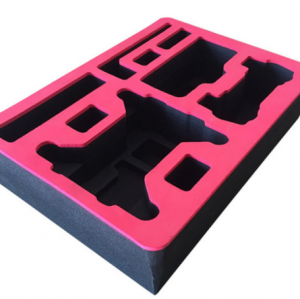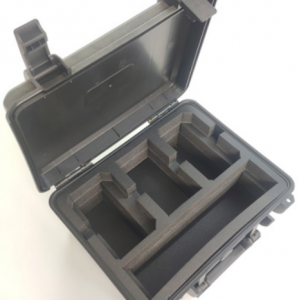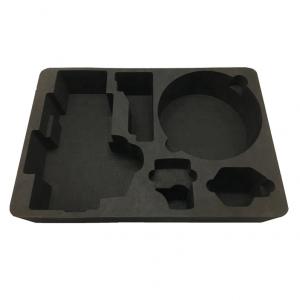

Blind slots, dividers and a retained foam base can combine location, separation, cushioning and quantity control in one lightweight tray.
How Can One 30 mm Anti-Static EPE Sheet Replace Dividers, a Base Pad and a Parts-Counting Fixture?
The main packaging problem for a small electronic part is not always a single dramatic drop. Repeated rubbing, compression in a loose bag, counting errors, mixed part numbers and slow manual handling can all create avoidable cost.
An array-style EPE tray brings location, separation, cushioning and quantity control into one piece of foam. The packaging becomes more than void fill: it becomes a simple logistics and visual-management tool.
1. How Does an EPE Array Tray Work?
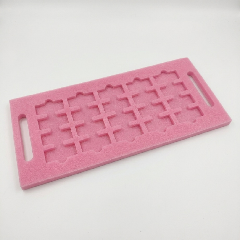
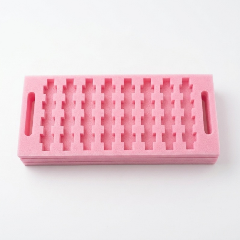
Consider a small electronic part measuring approximately 25 × 14 × 13 mm. A representative tray measures about 360 × 355 mm, uses 30 mm thick EPE, has pockets about 20 mm deep and retains approximately 10 mm of foam at the bottom. Repeated slots are arranged in fixed rows and columns.
Unlike a through-cut insert, a blind-slot construction allows one EPE sheet to form:
1. Individual locating pockets;
2. Dividers between adjacent products;
3. A bottom cushioning pad;
4. Fixed positions for quantity control;
5. Separation between stacked layers.
This can reduce separate dividers, loose base pads and manual assembly steps. A missing, extra or misplaced part is also easier to see.
2. Why Does This Structure Suit 28 kg/m³ EPE?
Flexible pocket walls locate the part gently
Low-density EPE allows the pocket walls to deform slightly as a part is inserted. Compared with a rigid plastic pocket, the foam can reduce local contact stress and is useful for products with scratch-sensitive surfaces or small exposed electronic features.
The pocket should not simply copy the nominal product dimensions. Product tolerance, cutting tolerance, foam-thickness variation, insertion direction and acceptable removal force must all be considered.
A retained base absorbs vertical input
Keeping approximately 10 mm of foam beneath the pocket prevents the part from contacting a hard work surface or carton panel directly. The base can absorb placement impact, transport vibration, vertical drops and localized pressure from packaging below.
If the pocket is cut completely through, a separate bottom sheet or another foam layer is normally required. A blind pocket can reduce the number of materials and assembly operations.
Fixed positions support error prevention and counting
Each pocket represents one part. Operators can quickly identify shortages, overfilling and mixed products. The tray can also show inspection status or work-in-process progress visually.
3. Weight and Material Efficiency
An uncut 360 × 355 × 30 mm EPE blank has a volume of approximately 0.00383 m³. At 28 kg/m³, its theoretical weight is only about 107 g before the pockets are cut.
|
With high-cavity-count trays, a small weight difference per tray becomes significant when multiplied across an annual shipment volume. |
A higher-density material may provide stronger dividers and longer service life, but one-way export packaging may not use those capabilities fully. The decision should start with reuse cycles, product mass and the cost of failure—not hardness alone.
4. Pocket Geometry Matters More Than Simply Increasing Density
Pocket width
Pocket width must balance location and handling. Too much clearance allows movement; too little clearance produces excessive grip and may force operators to pull on the product.
Pocket depth and bottom cushion
The pocket should be deep enough to prevent the part from jumping out while retaining sufficient foam underneath. Whether the part must sit below the tray surface also depends on stacking and the use of a top pad or lid.
Divider width
Dividers must withstand the lateral force generated during insertion and removal. A narrow critical web can tear during cutting, handling or repeated use, so it should be verified through cycle testing.
Finger access
If the product sits flush with the pocket wall, finger notches, a locally enlarged opening, staggered rows or a defined removal direction may be required. Handling efficiency is often more valuable than adding one extra pocket.
Array layout
Maximizing pocket count should not be the only objective. Perimeter strength, center-panel deflection, carton dimensions, hand clearance and machine-vision or counting requirements must also be considered.
5. How Does It Compare with Other Packaging Formats?
|
Packaging format |
Main characteristics |
|
Loose plastic bag |
Low cost, but allows contact, disorder and counting errors |
|
Paperboard grid |
Easy to convert, but limited cushioning, moisture resistance and durability |
|
Thermoformed tray |
Accurate, but requires tooling and creates harder contact |
|
EVA tray |
Durable and tear-resistant; useful for more reuse cycles |
|
IXPE tray |
Fine surface and good accuracy; normally higher cost |
|
28 kg/m³ EPE tray |
Lightweight, compliant and suitable for custom pockets and one-way export |
For long-term returnable use, automated handling or very tight location tolerances, EVA, IXPE or a thermoformed tray may be more appropriate. When low mass, customization, limited reuse and total cost are the priorities, EPE is often the stronger fit.
6. How Should the Anti-Static Performance Be Understood?
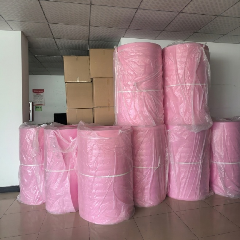
Pink anti-static EPE can reduce charge generation during contact and rubbing, but it is normally not a permanently dissipative material. The target surface-resistance range of this 28 kg/m³ grade is 10⁹–10¹¹ Ω, and the measured value can be affected by temperature, relative humidity, storage time, package sealing and surface wear.
Under suitable conditions, practical performance may remain acceptable for three to six months. For export orders with less predictable transport conditions, a conservative one-month warranty is recommended, together with a defined starting date, test method and storage conditions. Highly sensitive products should also use a shielding bag or another validated shielding package.
7. Information Needed for a Custom EPE Array Tray
• Product length, width, height, mass and dimensional tolerance;
• Product photographs, drawings or a 3D model;
• Required quantity per tray and insertion direction;
• Approved and prohibited contact areas;
• Carton inside dimensions, stacking method and expected reuse cycles;
• Anti-static requirement, storage environment and expected transit time.
Conclusion
The value of an EPE array tray is not simply that foam surrounds the product. With correctly designed blind pockets, dividers, a retained base and finger access, one 30 mm sheet can provide location, separation, cushioning, error prevention, counting and work-in-process handling.
|
For small electronic parts that require many custom positions, one-way export or limited reuse, 28 kg/m³ anti-static EPE can perform several packaging functions at low weight and cost. |