
YUFA POLYMER
1. Project Background
This case originated from a packaging requirement by a large electronics manufacturer in Northern Europe. The customer needed a customized tray solution for organizing, protecting, and transporting electronic components during their manufacturing and assembly processes. The trays had to provide permanent ESD protection, maintain dimensional stability, and accommodate specific component geometries while supporting high-volume production workflows.
The core packaging concept was to develop a custom thermoformed tray using ESD-safe polystyrene (PS) material. The tray design needed to precisely fit the customer's component dimensions, provide secure positioning during handling and transportation, and meet strict electrostatic discharge requirements for sensitive electronic parts.
2. Customer Packaging Challenges
The customer faced several critical packaging challenges in their electronics manufacturing operation:
· Electronic components required reliable ESD protection throughout the production cycle, from incoming inspection through assembly and final testing. Standard plastic trays without ESD properties posed unacceptable risk of electrostatic damage to sensitive components.
· The components had specific dimensions and geometries that required custom tray designs to ensure secure positioning, prevent movement during handling, and avoid component-to-component contact that could cause mechanical damage.
· The trays needed to withstand repeated use in a production environment, including multiple loading/unloading cycles, stacking, and exposure to manufacturing conditions without degradation of ESD performance or structural integrity.
· The customer required a cost-effective packaging solution that could be customized for different component types without the high tooling costs associated with injection molding, especially during the product development and validation phase.
· Fast turnaround time was essential. The customer needed the ability to iterate on tray designs quickly as component specifications evolved, with delivery timelines compatible with their production schedules.
· The trays needed to meet international ESD standards, with surface resistance values custom-designed according to the customer's specific ESD protection level requirements, ensuring permanent ESD-safe properties that would not diminish over time or with use.
3. YUFA POLYMER Solution
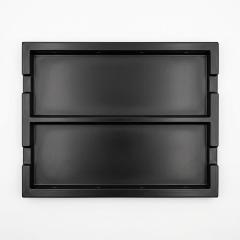
Figure 1: ESD_PS_TRAY Front-facing view
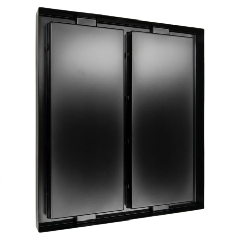
Figure 2: ESD_PS_TRAY Back-facing view
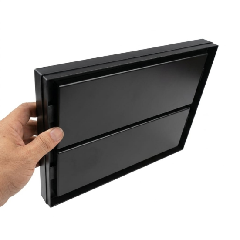
Figure 3: ESD_PS_TRAY Side-facing view
YUFA POLYMER proposed a custom ESD PS Thermoformed Tray solution specifically designed for electronic component packaging in manufacturing environments. This solution leverages the advantages of thermoforming technology combined with permanently ESD-safe polystyrene material to deliver a packaging system that balances performance, customization flexibility, and cost-effectiveness.
Unlike injection-molded trays that require expensive steel molds with long lead times, thermoformed trays use lower-cost tooling that enables faster design iterations and more economical customization. This makes the solution particularly suitable for customers who need to adapt packaging designs as product specifications change, or who require multiple tray variants for different component types without committing to high-volume production upfront.
4. Solution Structure
4.1 ESD PS Material: Permanent Electrostatic Protection
The trays are manufactured using ESD-safe polystyrene (PS) material with permanently embedded antistatic properties. Unlike surface-coated alternatives that can lose effectiveness through wear, cleaning, or environmental exposure, the ESD characteristics are integral to the material itself, ensuring consistent performance throughout the tray's service life.
· Surface resistance values can be designed according to customer requirements, flexibly matching different levels of ESD protection needs.
· Permanent ESD protection that does not degrade with time, use, cleaning, or environmental conditions.
· Black color provides visual contrast for component inspection and identification.
· Material thickness: 1mm, optimized for structural rigidity while maintaining lightweight characteristics.
· Compatible with cleanroom environments and suitable for direct contact with electronic components.
4.2 Thermoforming Process: Custom Design Flexibility
Thermoforming enables rapid customization of tray geometry to match specific component dimensions, shapes, and packaging requirements. The process involves heating ESD PS sheet material and forming it over custom molds to create precise cavity shapes that securely hold components in position.
· Custom cavity design based on customer component drawings and specifications.
· Lower tooling cost compared to injection molding, making it economical for small to medium production volumes.
· Fast tooling lead time enables quick design iterations and prototype validation.
· Ability to produce trays with complex geometries, undercuts, and precise dimensional tolerances.
· Suitable for both prototype quantities and series production runs.
· Tray dimensions can be precisely controlled to match automated handling equipment requirements.
4.3 Tray Design: Component-Specific Packaging
Each tray is designed according to the customer's specific component requirements. The tray in this case featured the following characteristics:
· External dimensions: 353.32 x 263.45 x 20mm, optimized for the customer's component size and handling equipment.
· Dual-compartment configuration to separate and organize different component types or provide structural reinforcement.
· Precise cavity depths and wall angles to ensure secure component retention during handling and transportation.
· Reinforced edges and structural ribs to maintain tray rigidity under stacking loads.
· Smooth interior surfaces to prevent component scratching or contamination.
· Design optimized for efficient nesting and stacking to minimize storage and transportation space requirements.
5. Manufacturing and Quality Control
YUFA POLYMER implemented a structured manufacturing process to ensure consistent quality and ESD performance:
· Design review and tooling design based on customer component specifications and packaging requirements.
· Mold fabrication using precision CNC machining to achieve required dimensional accuracy.
· Material selection and incoming inspection to verify ESD PS material properties and compliance with specifications.
· Thermoforming production: due to the nature of the thermoforming process, wall thickness varies at different positions of the tray. Structural strength is enhanced through reinforcing ribs at stress points while maintaining consistent material thickness. Batch-to-batch wall thickness distribution is controlled for consistency, ensuring dimensional stability.
· In-process quality checks including dimensional verification, visual inspection, and ESD resistance testing.
· Final inspection and testing before packaging, with ESD resistance verification on sample basis per batch.
· Clean packaging in ESD-safe materials to prevent contamination during transportation.
6. Suitable Applications
Based on the ESD protection, custom design capability, and cost-effective production characteristics, ESD PS Thermoformed Trays are suitable for a wide range of electronic component packaging applications:
· Semiconductor devices, ICs, and integrated circuits requiring ESD-safe handling and storage.
· PCB assemblies, circuit boards, and electronic modules during manufacturing and testing processes.
· Connectors, sensors, and electronic components in automotive, industrial, and consumer electronics production.
· LED components, optoelectronic devices, and other light-sensitive electronic parts.
· Medical electronics and devices requiring controlled ESD environments.
· Prototype components and engineering samples during product development phases.
· High-mix, low-to-medium volume production environments where packaging flexibility is essential.
· Any application requiring custom-shaped trays for specific component geometries without high tooling investment.
7. Solution Value
The ESD PS Thermoformed Tray solution delivered multiple value benefits to the customer:
· Permanent ESD protection throughout the tray lifecycle, eliminating risk of electrostatic damage to sensitive components.
· Custom tray design precisely matched to component dimensions, ensuring secure positioning and preventing mechanical damage.
· Cost-effective tooling with fast turnaround, enabling rapid design iterations and compatibility with evolving product specifications.
· Lightweight yet rigid construction that protects components while minimizing material usage and transportation costs.
· Scalable production capability from prototype quantities to series production volumes.
· Consistent quality and ESD performance verified through systematic quality control processes.
· Reduced packaging complexity with a single-material solution that provides both structural protection and ESD safety.
· Support for the customer's production efficiency through trays designed for easy loading, unloading, and integration with handling workflows.
8. Customer Selection Guidance
Customers considering ESD PS Thermoformed Tray solutions should evaluate the following factors:
· Component dimensions and geometry: Thermoformed trays can be customized to fit specific component shapes and sizes. Provide detailed component drawings or samples for accurate tray design.
· Production volume and timeline: Thermoforming is particularly cost-effective for small to medium volumes and offers faster tooling lead times than injection molding. For very high volumes, injection molding may become more economical.
· ESD requirements: Confirm the required ESD performance level. The surface resistance of ESD PS material can be designed according to the customer's actual protection requirements rather than being limited to a fixed range. YUFA POLYMER can provide customized ESD solutions based on specific application scenarios.
· Environmental conditions: Consider operating temperature range, chemical exposure, and cleanliness requirements. ESD PS is suitable for standard manufacturing environments but may have limitations in extreme conditions.
· Stacking and handling requirements: Specify stacking loads, automated handling compatibility, and any special requirements for integration with existing production equipment.
· Design iteration needs: If packaging designs are expected to change frequently during product development, thermoforming offers the flexibility to modify trays without major tooling reinvestment.
9. Conclusion
The ESD PS Thermoformed Tray solution successfully addressed the Northern European electronics manufacturer's requirements for custom component packaging with permanent ESD protection. By combining the design flexibility of thermoforming technology with permanently ESD-safe polystyrene material, YUFA POLYMER delivered a packaging system that provides reliable component protection, supports production efficiency, and offers cost-effective customization capabilities.
This solution demonstrates YUFA POLYMER's ability to develop tailored packaging solutions that meet the specific needs of electronics manufacturing customers, balancing performance requirements with practical considerations of cost, lead time, and design flexibility. The thermoformed tray approach is particularly valuable for customers who need custom packaging solutions without the high tooling costs and long lead times associated with injection molding, making it an ideal choice for product development phases, medium-volume production, and applications requiring frequent packaging design updates.
10. Company Information
Email: info@yufapolymer.com
Web: www.yufapolymer.com
Location: Shenzhen, China