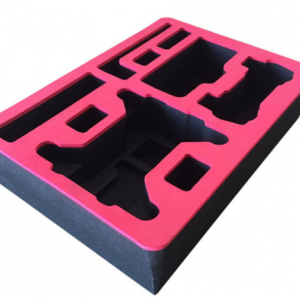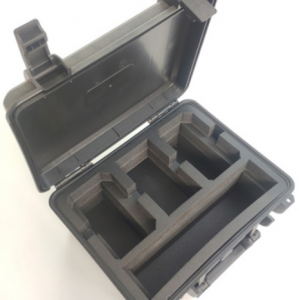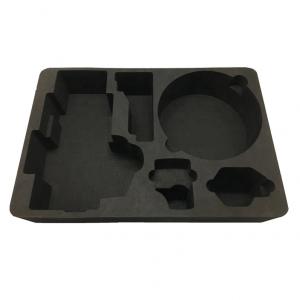

One 494 × 220 mm footprint, 19 cavity SKUs, 5 thicknesses — how YUFA POLYMER supports EMS line-side kitting in the EU cloud-infrastructure supply chain.
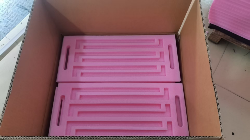
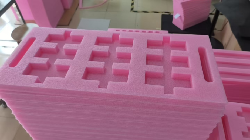
Pink ESD EPE foam trays — packed and ready for shipment to the EU customer.
Project Snapshot
|
Item |
Detail |
|
Client |
Confidential — Tier-1 EMS-ODM in the cloud & networking equipment sector |
|
Region |
Central Europe |
|
End-market served |
Hyperscale server, networking, and AI compute assemblies for EMEA |
|
Product supplied |
Pink ESD EPE foam trays — 19 cavity SKUs on one common footprint |
|
Tray footprint (L × W) |
494 × 220 mm |
|
Thicknesses |
10 / 15 / 20 / 25 / 30 mm (5 standard heights) |
|
Cover dimensions |
494 × 220 × 10 mm (flat lid, common to all SKUs) |
|
Material |
ESD EPE (expanded polyethylene), 28 kg/m³ |
|
Surface resistivity |
10⁹ – 10¹¹ Ω (static-dissipative) |
|
Color |
Pink (industry-recognized ESD dissipative code) |
|
Special SKU |
One multi-layer stacked tray for full sub-assembly kitting |
|
Process |
Die-cut top sheet bonded to a solid EPE base sheet |
|
Supplier |
YUFA POLYMER |
1. Client Background
The customer is a Tier-1 EMS-ODM operating a large European manufacturing site that produces cloud, networking, and AI-compute equipment — servers, switches, routers, and related sub-assemblies — for hyperscale and enterprise brands. The plant runs a high-mix, mid-to-high-volume model: dozens of end-product SKUs share the same lines, and each SKU consumes tens of small, ESD-sensitive components (connectors, DIMMs, optical modules, cages, brackets, shielding cans, standoffs). Operating in the EU, the site must also meet packaging-sustainability reporting obligations (CSRD, PPWR, EcoVadis).
2. The Challenge
Packaging on a high-mix server / networking line has to reconcile several constraints at once — a combination that ordinary anti-static packaging is rarely optimized for:
· ESD compliance across every component. All parts arriving at the SMT-post and final-assembly stations are ESD-sensitive; every packaging surface that touches them must sit in the static-dissipative window (10⁶ – 10¹¹ Ω) per ANSI/ESD S20.20.
· Wide part-height range. Component heights vary from ~4 mm (DIMMs, shims) up to ~30 mm (QSFP cages, heatsink clips). A single tray thickness either wastes material on short parts or crushes tall ones.
· High SKU velocity. Changeovers happen multiple times per shift, and new part layouts are introduced continuously — the packaging model has to accept fast, low-NRE iteration to keep up.
· Cushioning for delicate components. Connectors, optical modules and DIMMs must sit on a compliant surface that absorbs vibration and handling shocks without deforming under stack load.
· EU sustainability reporting. Packaging materials that are difficult to sort into a single recycling stream are increasingly hard to justify under CSRD / PPWR audits.
3. The Solution — a modular tray platform, not a one-off part
YUFA POLYMER engineered a modular Pink ESD EPE foam tray platform. Instead of designing 19 independent parts, we standardized one 494 × 220 mm footprint and one 10 mm-thick flat lid, then derived 19 cavity SKUs across 5 standard thicknesses (10 / 15 / 20 / 25 / 30 mm) — including one multi-layer stacked tray that consolidates an entire sub-assembly kit into a single carrier.
Platform architecture:
· Common outer footprint 494 × 220 mm — compatible with standard EUR-pallet sub-modules and typical line-side flow racks; a single lid SKU (494 × 220 × 10 mm) closes every tray in the family.
· 5 standard thicknesses (10 / 15 / 20 / 25 / 30 mm) — height class is selected per part family instead of per part, minimizing over-packaging and material waste.
· 19 cavity SKUs grouped into 4 layout families:
· • Layout L — long parallel slots for elongated items (DIMMs, riser cards, long PCBs, busbars, stick modules).
· • Layout G — high-density grid pockets for small rectangular parts (connector housings, terminal blocks, standoffs, shielding cans).
· • Layout X — cross / H-shaped and irregular pockets for structural parts (brackets, heatsink clips, QSFP/SFP+ cages, ejector levers).
· • Layout M — one multi-layer stacked tray that holds a full station-ready sub-assembly kit (multiple part types, different heights) in a single tray.
· Ergonomic dual side-slot handles on every tray — one-operator handling; stackable with the flat lid to close dust, light, and minor impact paths.
· Pink as a visual work-cell code — an operator can identify the ESD zone at a glance, reinforcing the ESD-safe workflow without extra signage.
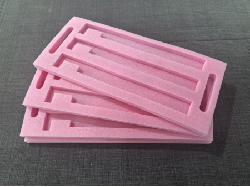
Layout L — long parallel slots for DIMMs, riser cards, long PCBs.
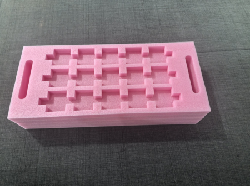
Layout G — high-density grid pockets for connectors and small housings.
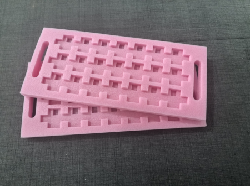
Layout X — cross / H-shaped pockets for brackets, cages and clips.
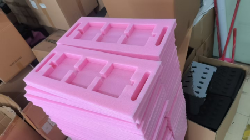
Layout X (large) — deep pockets for larger structural parts.
Why ESD EPE foam is the right base material here:
· Volume-type static dissipation. YUFA's pink ESD EPE uses a polymer-compatible antistatic additive that is dispersed through the full cross-section of the foam. Cut edges, cavity walls, and lid faces all sit inside the 10⁹ – 10¹¹ Ω dissipative window — there is no non-ESD substrate exposed after die-cutting.
· Cushioning combined with load support. At 28 kg/m³, EPE offers elastic recovery under handling shocks while still supporting the stack weight of a full tray column — parts sit on a compliant, vibration-damping surface.
· Fast, low-NRE iteration. Cavities are die-cut with steel-rule dies, so a new cavity SKU can be added to the platform in days instead of weeks, at a fraction of the tooling cost of most alternatives.
· Mono-material construction. Base sheet and top sheet are both LDPE-based EPE, bonded without introducing foreign polymers — the finished tray enters the polyethylene recycling stream as a single-polymer article, which supports the customer's CSRD / PPWR / EcoVadis reporting.
Engineered specification:
|
Property |
Specification |
Benefit |
|
Surface resistivity |
10⁹ – 10¹¹ Ω |
Static-dissipative range — bleeds charge without spark risk; supports ANSI/ESD S20.20 (ESD TR53) packaging requirements. |
|
Material density |
28 kg/m³ EPE |
Balanced load support and cushioning across the full 19-SKU platform. |
|
Antistatic mechanism |
Volume-dispersed polymer-compatible antistat |
ESD performance present through the full cross-section — die-cut edges remain dissipative. |
|
Tray footprint |
494 × 220 mm (common to all 19 SKUs) |
One standardized outer shape — pallet-, rack-, and handling-compatible across the family. |
|
Thicknesses |
10 / 15 / 20 / 25 / 30 mm (5 heights) |
Height class selected per part family; minimizes over-packaging. |
|
Lid |
Flat EPE sheet, 494 × 220 × 10 mm — 1 SKU covers all trays |
Simple SKU management; stack-and-close in seconds. |
|
Cavity forming |
Die-cut top layer bonded to a solid base layer |
Fast tooling; new cavity SKUs added in days. |
|
Color |
Pink |
Industry-recognized visual code for ESD-dissipative packaging. |
|
Material class |
Mono-material LDPE-based foam, halogen-free |
Enters the polyethylene recycling stream as a single-polymer article. |
4. Implementation — how the 19-SKU tray family was rolled out
The customer only had to share the packaging brief and part information; YUFA POLYMER handled every step from platform architecture to serial delivery.
· Step 1 — Brief intake. Customer sends 2D drawings, part photos, and key dimensions for every part family that needs a cavity.
· Step 2 — Platform design. YUFA locks the outer footprint (494 × 220 mm) and lid, then derives 19 cavity SKUs across 5 standard thicknesses — including one multi-layer sub-assembly tray. DXF and 2D / 3D previews are shared for sign-off.
· Step 3 — Die tooling. A steel-rule die is produced for each of the 19 cavity SKUs.
· Step 4 — Fast-delivery production. Die-cut top sheets are laminated to solid base sheets and, where applicable, to intermediate layers for the multi-layer tray.
· Step 5 — QC and release. Every batch is checked for surface resistivity per ANSI/ESD STM11.11 (representative-sample basis), plus dimensional and visual inspection. Trays are packed and shipped.
Note: EPE foam has an open-cell structure, so CNC milling is not used — die-cutting plus lamination delivers cleaner edges, faster cycle time, and lower unit cost.
Cavity close-up — clean die-cut edges on 28 kg/m³ pink ESD EPE, with volume-dispersed antistat visible across every cut face.
5. Value Delivered
Quantified outcomes on this program:
|
Value lever |
Outcome (this program) |
|
Footprint standardization |
One 494 × 220 mm outer size covers 19 cavity SKUs — line-side flow racks and pallet patterns are unchanged when a SKU is added. |
|
Height coverage per platform |
10 – 30 mm span covered by 5 stocked thicknesses (10 / 15 / 20 / 25 / 30 mm). |
|
Time to add a new SKU |
3 – 7 days from confirmed drawing to sample (new steel-rule die only). |
|
Sub-assembly consolidation |
One multi-layer tray (Layout M) replaces multiple single-layer carriers for station-ready kitting. |
|
Cushioning + load support |
28 kg/m³ EPE — compliant seating for delicate components; stackable without crushing parts below. |
|
ESD compliance |
Volume-dissipative 10⁹ – 10¹¹ Ω, stable across every die-cut face; documented per ANSI/ESD STM11.11. |
|
Recyclability |
Mono-material LDPE foam — compatible with polyethylene recycling streams; supports CSRD / PPWR / EcoVadis reporting. |
|
Reusability |
Trays are reusable across multiple shipping / kitting cycles, extending useful life beyond a single trip. |
6. Why This Matters for EMS / ODM Sites Beyond This Program
If you run a high-mix server, networking, or AI-compute assembly site anywhere in the EMS / ODM ecosystem — Central Europe, Mexico, Southeast Asia, or Greater China — three constraints converge: certifiable ESD protection, line-side kitting speed for weekly-changing bills of material, and demonstrable recyclability under increasingly strict regional packaging rules. A modular ESD EPE tray platform answers all three with a single tooling model. Because the outer footprint is standardized, a proven platform on one line can be replicated on sister lines — and sister plants — without re-engineering flow racks or pallet patterns.
The design principle is simple: don't specify a package per part — specify a platform per line, and let cavity SKUs evolve inside it.
7. Engage YUFA POLYMER
YUFA POLYMER designs and manufactures custom ESD EPE, EPS, and XPE foam packaging, as well as ESD thermoformed trays, for electronics, automotive, medical, and industrial customers worldwide. Send us a 2D drawing, a photo of the parts, or a full assembly BOM — we will return a cavity-layout design and a quotation within days.
Get a free design review and quotation:
· Website: www.yufapolymer.com
· Email: info@yufapolymer.com
© YUFA POLYMER — ESD Protective Packaging Solutions