
https://youtu.be/AQKQ3yNMn6k?si=yJdR3YfARbABQbNY
5 slanted-opening bins + 8 lidded component boxes — 13 existing models in total. Screen by the opening for high-frequency picking, by closed-lid internal space for sorted storage, then match the resistance range.
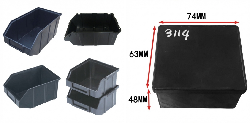
Fig. 1 Left: ESD slanted-opening bins (hanging style, stackable); right: lidded ESD component box (PP models with hinged lid). Category illustration only — dimensions and structures are subject to the corresponding product code.
01 Applications | 02 Overview of 13 models | 03 Slanted-opening bins | 04 Component boxes | 05 Resistance | 06 Internal dimensions | 07 Accessories | 08 Product codes | 09 FAQ | 10 How to start
In the storage and circulation of small electronic parts, the terms "parts bin", "component box" and "storage bin" are often used interchangeably: some buyers want a slanted-opening bin for quick access at the workstation, some want a lidded component box that can be closed and carried away, and many operations need both. In Yufa's existing ESD injection-moulded series, the two product types coexist: 5 slanted-opening bins (Sloping Bins) and 8 lidded component boxes (Component Boxes) — 13 models in total.
The two types do not solve the same problem. Slanted-opening bins are for high-frequency access, where the opening is the working surface; lidded component boxes are for sorted storage, dust protection and carrying, where the usable space under the closed lid is what counts. Define the handling action first, screen the 13 existing models by size, then check the resistance range — this order is faster than starting with the price.
1. What Buyers Really Look for When Searching "ESD Parts Bins"
In search queries, slanted-opening bins and lidded component boxes often fall under the same term (ESD bins / ESD component boxes). On the production line, however, they answer four different scenarios:
• Line-side picking: placed on a rack or the workstation top, small parts taken as needed — the concerns are opening height, smooth access and visual identification.
• Sorted storage: several part numbers managed in separated cells — the concerns are internal dimensions and cell division.
• Dust protection and carrying: semi-finished parts or small batches moving with the work order — the concerns are protection and internal space under the closed lid.
• ESD compliance: audits require the surface resistance range of storage equipment — the concern is the material system and its documentation.
All four scenarios point to the same prerequisite: define the action first. "Frequent access" and "covered storage" place opposite demands on the structure — which is why this article compares the two types side by side: clarify the direction first, then screen by size.
2. Overview: 5 Slanted-Opening Bins + 8 Lidded Component Boxes
The two types are not symmetrical in material coverage or structure (Table 1).
|
Type |
Models |
Material coverage |
Structural features |
External size range |
|
ESD slanted-opening bin |
5 |
Anti-static PP alloy only (10⁴–10⁸ Ω) |
Hanging style, stackable; no lid |
External length 130–300 mm |
|
ESD component box with lid |
8 |
2 PP-alloy + 6 PP models |
All with lids (6 PP models with hinged, replaceable lids); dividers optional on some models |
External length 74–230 mm |
Both types are listed model by model below (Tables 2 and 3). All 5 slanted-opening bins are anti-static PP alloy. Component boxes exist in both materials, with the resistance range bound to the size segment — the two 200 mm-class models are PP alloy, while the six palm-size models (74–140 mm) are all PP.
3. Slanted-Opening Bins: 5 Models, All PP Alloy, by External Length
All 5 models are anti-static PP alloy, surface resistance 10⁴–10⁸ Ω, hanging style and stackable (Table 2).
|
Product code |
External size (mm) |
Internal size (mm) |
Weight (kg) |
Structure |
|
IMBIN-PPA-130-125-65 |
130 × 125 × 65 |
110 × 108 × 57 |
0.10 |
Hanging style, stackable |
|
IMBIN-PPA-160-100-70 |
160 × 100 × 70 |
147 × 85 × 65 |
0.13 |
Hanging style, stackable |
|
IMBIN-PPA-200-130-90 |
200 × 130 × 90 |
180 × 110 × 80 |
0.25 |
Hanging style, stackable |
|
IMBIN-PPA-235-157-121 |
235 × 157 × 121 |
215 × 140 × 112 |
0.39 |
Hanging style, stackable; optional divider and label holder |
|
IMBIN-PPA-300-155-137 |
300 × 155 × 137 |
284 × 140 × 127 |
0.55 |
Hanging style, stackable |
• Internal height is consistently 5–10 mm lower than external height. The smallest gap is 5 mm on IMBIN-PPA-160-100-70; IMBIN-PPA-200-130-90 and IMBIN-PPA-300-155-137 differ by 10 mm — estimating load height from the external figure will overestimate at the limits.
• All models are hanging-style and stackable. The hanging edge fits racks, back panels or workstation louvre boards; when stacking on the floor, confirm stability at the planned stack height.
• IMBIN-PPA-235-157-121 is the only model with an optional divider and label holder — a good fit for workstations that both pick fast and manage part numbers.
• IMBIN-PPA-300-155-137 is the largest model at 0.55 kg, roughly 5 times the smallest IMBIN-PPA-130-125-65 — check the rack load rating when fully loaded.
4. Lidded Component Boxes: 8 Models, All with Lids, Two Material Segments
All 8 models come with lids. The two PP-alloy models sit in the 200 mm class; the six PP models are palm-size, 74–140 mm (Table 3). Internal dimensions in the table are the usable space under the closed lid.
|
Product code |
Material & surface resistance |
External size (mm) |
Closed-lid internal size (mm) |
Weight (kg) |
Structure |
|
IMBOX-PPA-205-125-50 |
Anti-static PP alloy 10⁴–10⁸ Ω |
205 × 125 × 50 |
193 × 114 × 42 |
0.25 |
With lid; optional divider |
|
IMBOX-PPA-230-160-65 |
Anti-static PP alloy 10⁴–10⁸ Ω |
230 × 160 × 65 |
220 × 150 × 55 |
0.35 |
With lid |
|
IMBOX-PP-140-95-38 |
Anti-static PP 10⁵–10⁹ Ω |
140 × 95 × 38 |
140 × 90 × 31 |
0.098 |
Hinged lid (replaceable) |
|
IMBOX-PP-110-80-45 |
Anti-static PP 10⁵–10⁹ Ω |
110 × 80 × 45 |
109 × 78 × 43 |
0.083 |
Hinged lid (replaceable) |
|
IMBOX-PP-100-85-33 |
Anti-static PP 10⁵–10⁹ Ω |
100 × 85 × 33 |
96 × 80 × 26 |
0.063 |
Hinged lid (replaceable) |
|
IMBOX-PP-79-54-29 |
Anti-static PP 10⁵–10⁹ Ω |
79 × 54 × 29 |
75 × 48 × 25 |
0.030 |
Hinged lid (replaceable) |
|
IMBOX-PP-74-63-48 |
Anti-static PP 10⁵–10⁹ Ω |
74 × 63 × 48 |
70 × 58 × 44 |
0.043 |
Hinged lid (replaceable) |
|
IMBOX-PP-74-53-29 |
Anti-static PP 10⁵–10⁹ Ω |
74 × 53 × 29 |
70 × 48 × 20 |
0.028 |
Hinged lid (replaceable) |
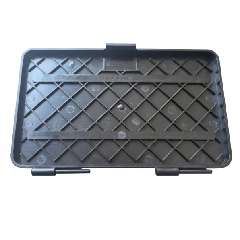
The six PP models share the single most operationally relevant feature: a hinged lid. Two hinge pins on the rear edge of the lid sit in holes in the rear wall of the box — flip open, snap shut. When needed, withdraw the pins from the holes and the whole lid can be taken off and replaced separately. In daily use the lid always stays with the box: it cannot be lost or misaligned, and it opens and closes one-handed while the box travels with the work order. This structure covers 6 of the 8 models and explains why lidded component boxes work so well on the production line: the lid is always on the box, and it can be replaced whenever needed.
Fig. 2 Close-up of the hinged lid on the six IMBOX-PP models: two hinge pins on the rear edge of the lid — withdraw the pins to remove and replace the whole lid.
• The two PP-alloy models: IMBOX-PPA-205-125-50 offers an optional divider; IMBOX-PPA-230-160-65 is the largest of the series with 55 mm of internal height under the closed lid.
• The six PP models weigh only 28–98 g, ideal for subdivided storage in workstation drawers, tool carts and dry cabinets.
• IMBOX-PP-74-53-29 and IMBOX-PP-79-54-29 look almost identical (74 × 53 × 29 vs 79 × 54 × 29). The real difference is closed-lid internal height: 20 mm vs 25 mm — fit the product by these numbers, not by the external height.
• IMBOX-PP-74-63-48 is the only "squat" format: a 74 × 63 footprint, 48 mm external height and 44 mm internal height under the closed lid, suitable for upright small parts.
5. Resistance: Two Ranges, Bound to the Model
The two material systems remain: anti-static PP alloy, surface resistance 10⁴–10⁸ Ω; anti-static PP, surface resistance 10⁵–10⁹ Ω. Unlike the trays and reel boxes — where every model comes in both material versions — the resistance range here is bound to the model:
• All 5 slanted-opening bins exist only in the PP-alloy range. A bin in the 10⁵–10⁹ Ω range does not exist in the current line and can only be reviewed per project.
• Component boxes offer both ranges, but split by size segment: the 200 mm class exists only in PP alloy, the palm-size class only in PP — choosing the material is effectively choosing the size band.
So define structure and size first, then check whether the resistance falls within the customer's ESD specification. If the specification pins down the other range, say so at the inquiry stage instead of selecting by appearance first. Until the corresponding TDS or test report is available, "conductive" or a specific standard number should not be used as the selection basis.
6. Internal Dimensions: Bins by Opening Access, Boxes by Closed-Lid Space
Internal dimensions in Tables 2 and 3 are nominal. The usability test differs between the two types:
• Slanted-opening bins: picking efficiency is decided by the opening direction and the usable opening — internal volume alone says little. Whether a loaded product can be withdrawn smoothly through the slanted opening, with room for the fingers, must be verified on a sample: "seeing the product" is not the same as "accessing it smoothly".
• Component boxes: internal dimensions are the usable space under the closed lid. The gap between closed-lid internal height and external height ranges from 2 mm (IMBOX-PP-110-80-45) to 10 mm (IMBOX-PPA-230-160-65) — calculate with "part height + closed-lid clearance". A lid pressing on the parts is the most common cause of rework in this category. The swing clearance the hinged lid needs is part of the same check.
Injection-moulded parts have normal moulding tolerance. If a component box must mate tightly with a drawer or dry-cabinet shelf, or a bin must hang on a rack of a specific size, send the mating dimensions and tolerance requirements together and confirm by model.
7. Accessories and Lids: Only Two Models Offer Options; Keep the Lid Policy Clear
• IMBIN-PPA-235-157-121 (bin): optional divider and label holder. A divider occupies part of the opening area — confirm each cell size together with the access direction when selecting.
• IMBOX-PPA-205-125-50 (component box): optional divider. Under the closed lid, divider height is limited by the internal height — calculate from 42 mm internal, not 50 mm external.
• Other models list no accessory options. For cell division, die-cut dividers or foam cells can be added per project — no new tooling is needed just for dividers.
• Lid policy: slanted-opening bins are never supplied with lids; for dust protection, carrying and closed-lid management, go directly to the lidded component boxes. The six PP models use hinged lids that stay with the box and can be released from the pins and replaced as a whole.
8. Using Product Codes to Handle Inquiries
Once a close model is found, send the product code to Yufa to continue. The code carries the category, material segment and external dimensions:
|
Product code |
How to read it |
|
IMBIN-PPA-235-157-121 |
Slanted-opening bin · anti-static PP alloy (10⁴–10⁸ Ω) · external 235 × 157 × 121 mm · hanging style, stackable |
|
IMBOX-PP-140-95-38 |
Lidded component box · anti-static PP (10⁵–10⁹ Ω) · external 140 × 95 × 38 mm · hinged lid |
The code shortens communication but does not replace project confirmation: opening and access method, closed-lid clearance, accessory combination and resistance range are still confirmed per model before ordering.
9. Frequently Asked Questions
Q: Can a slanted-opening bin replace a lidded component box?
A: Not directly. Slanted-opening bins are built for high-frequency access and visual management; lidded component boxes are built for sorted storage, dust protection and carrying. The two often coexist at the same workstation.
Q: Can slanted-opening bins be supplied with lids?
A: Not in the standard series. The value of a slanted-opening bin is access through the opening; adding a lid removes that advantage. For dust protection, choose a lidded component box, or discuss alternatives per project.
Q: Does "with lid" mean the box is sealed?
A: No. "With lid" describes the structure only. Waterproof, moisture-proof, air-tight or cleanroom requirements must be confirmed separately by structure.
Q: Can the lid of the PP component boxes be removed and replaced separately?
A: Yes. The lid connects to the box through two hinge pins on its rear edge; withdraw the pins from the holes in the box rear wall and the whole lid can be taken off and replaced separately. In daily use the lid stays on the hinge — flip open, snap shut — so it is never lost or misaligned, ideal for frequent opening and closing while travelling with the work order.
Q: How to choose between two near-identical models (e.g. IMBOX-PP-74-53-29 and IMBOX-PP-79-54-29)?
A: Check the closed-lid internal space. IMBOX-PP-74-53-29 has 20 mm internal height, IMBOX-PP-79-54-29 has 25 mm, and the internal footprints differ (70 × 48 vs 75 × 48). Fit the product into the internal dimensions, not the external ones.
Q: Can dividers or label holders be added?
A: IMBIN-PPA-235-157-121 offers an optional divider and label holder; IMBOX-PPA-205-125-50 offers an optional divider. Other models list no accessory options — cell division can also be achieved with die-cut dividers or foam per project.
Q: How about MOQ and pricing?
A: All 13 models are standard items. MOQ and pricing are confirmed by model and order quantity; the larger the quantity, the lower the unit price.
10. How to Start the Selection
If a close model is already found in Tables 2 and 3, send the product code and estimated quantity. If not yet decided, provide Yufa with the following:
• Handling action: high-frequency line-side picking, or sorted storage, dust protection and carrying; whether the lid should stay with the box (hinged lid, replaceable)
• Product information: part dimensions, weight and loading quantity; whether dividers are needed
• Internal-space requirements: access direction for bins; cell size and closed-lid clearance for component boxes
• Mounting: hanging (rack / back-panel specification), desktop placement or stacking
• Target ESD requirement: surface resistance range or audit standard
• Estimated quantity; if a close model is already identified, quote its product code
With this article, the category series of Yufa's ESD injection-moulded range — the comprehensive guide, 600 × 400 boxes, injection-moulded trays, slanted-opening bins and lidded component boxes, and reel boxes — is complete. Read together, the five articles map out the full selection picture for ESD injection-moulded handling equipment.
|
Send the handling action and product dimensions to Yufa — start from the 13 existing models. |
We first define the direction between bins and component boxes by handling action, then screen by internal dimensions and resistance range — instead of pushing the project straight to custom tooling. |
Editor's note: this file is the English version of the confirmed Chinese draft. Tables are plain Word tables for direct copy-paste into the CMS.