
A customer-focused comparison of ESD EVA, IXPE and EPE foam
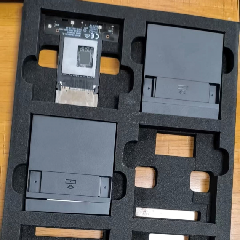
There Is No Single “Best” Foam—Only the Right Solution for the Project
ESD EVA, IXPE and EPE can all be fabricated into trays, dividers and custom inserts for electronic products. However, they differ in thickness options, appearance, fabrication methods, ESD service life and total finished cost. Customers do not need to select a material first. A better approach is to share the product, operating process and purchasing requirements, then let the supplier match the material and structure to the application.
|
Quick Takeaway Consider EVA first for thick one-piece structures or complex CNC-machined cavities; consider IXPE when surface finish and permanent ESD performance matter; consider EPE for lightweight, short-cycle die-cut packaging. The final choice must still account for the drawing, operating habits, quantity and budget. |
Start with How the Customer Uses the Packaging
The insert should fit the customer’s existing packing, loading, unloading and handling habits—not force the customer to change established operations. Product orientation, access frequency, vulnerable areas and available box space all affect the material and structure. Detailed corner radii, cavities, layer counts and tolerances should be confirmed after the Yufa team reviews the drawing and sample.
Core Comparison of Three ESD Foams
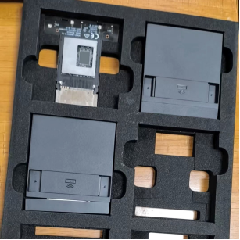
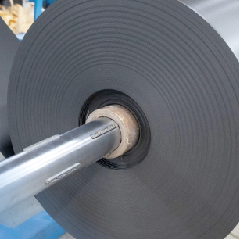
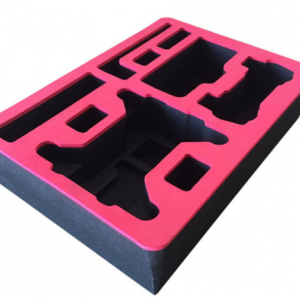
ESD IXPE
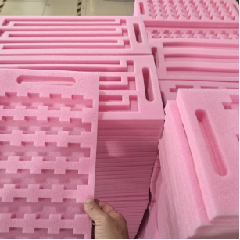
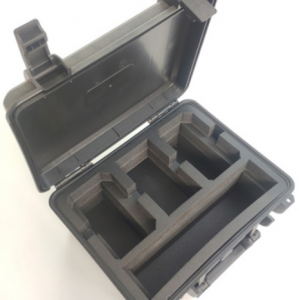
ESD EPE
|
Comparison |
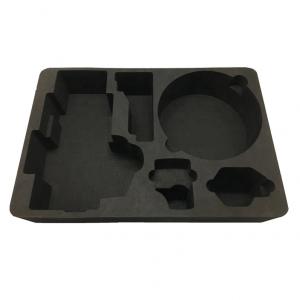
ESD EVA |
ESD IXPE |
ESD EPE |
|
Key specification |
Shore C 38±5; density 65±5 kg/m³ |
Density 45±5 kg/m³ |
Density 28±3 kg/m³ |
|
Single-layer thickness |
Cut to order; maximum 50 mm |
5±0.3 mm |
5±0.3 mm |
|
Greater finished thickness |
Cut directly from thick block; use ESD adhesive for assembled structures |
Multi-layer thermal lamination |
Multi-layer thermal lamination |
|
Surface appearance |
No IXPE-type integral surface skin |
Original material has an integral surface skin |
Lightweight; laminated layers may be visible |
|
Surface resistance |
1.0×10⁵–1.0×10⁹ Ω |
1.0×10⁵–1.0×10⁹ Ω |
1.0×10⁹–1.0×10¹¹ Ω |
|
Static decay |
< 2.0 seconds |
< 2.0 seconds |
< 2.0 seconds |
|
ESD service life |
Permanent |
Permanent |
6 months from manufacture |
|
Main fabrication methods |
Cutting, die cutting, CNC machining and ESD-adhesive bonding |
Die cutting, bonding, CNC machining and thermal lamination |
Die cutting and thermal lamination; CNC not recommended |
|
Consider first for |
Thick inserts, deep cavities and long-term circulation |
Fine appearance, flexibility and long-term ESD protection |
Lightweight, short-cycle packaging |
Four Factors Customers Should Consider
1. Value Means Total Finished Cost
Foam price alone does not determine value. Layer count, tooling, CNC time, lamination, material yield, packing efficiency and number of reuse cycles all affect total cost. Multi-layer IXPE or EPE should be compared with thick-block EVA against the actual drawing.
2. Production Efficiency Depends on Structure and Quantity
CNC is often practical for prototypes and small batches, while die cutting may be evaluated for stable medium- or high-volume designs. The final process must also consider cavity depth, corner radii, layer count and tolerances—not order quantity alone.
3. Safety Includes Both ESD and Transit Protection
Surface resistance is only one part of material selection. The design must also confirm whether the product is secured correctly, whether vulnerable areas are supported and whether compression may occur during handling or transport.
4. Inserts Can Be Integrated with ESD Boxes
Depending on the project, foam inserts can be paired with ESD injection-molded boxes, ESD hollow-sheet boxes or ESD corrugated cartons. The box and insert should be considered together, including usable internal dimensions, handling method and transport requirements.
What Information Should You Send to Yufa?
• If a product drawing is available, send the drawing and indicate the foam material you normally use.
• If no drawing is available, simply describe the application and approximate dimensions; Yufa can assist with the design.
|
Next Step This table can narrow the options, but the final solution should be confirmed by the Yufa team based on the product drawing, operating habits and purchasing conditions, by sample-fit verification. |
|
Need help with an ESD packaging project? Send us your product drawing and preferred foam material, or simply describe the application and approximate dimensions. Yufa can help develop a suitable solution. Yufa Polymer Products Co., Ltd. Email: info@yufapolymer.com | Website: www.yufapolymer.com |