
In electronics manufacturing, PCB assembly, SMT production lines, laboratories and ESD protected areas, a chair is not just a workplace accessory. Operators can generate or transfer static electricity when sitting, moving, turning or working close to sensitive components. If the chair surface and structure do not support a controlled static discharge path, the risk of electrostatic damage may increase.
That is why buyers should not evaluate an ESD chair only by appearance or price. A reliable ESD chair should combine static-control performance, workstation compatibility, ergonomic support and stable repeat purchasing. For most electronics workshops and laboratories, a proven standard ESD chair is often a more practical choice than an over-complicated customized model.
1. Why an ESD Chair Is Different from an Office Chair
A standard office chair is mainly designed for comfort. An ESD chair must support both comfort and static control. In an EPA environment, the seat surface, backrest, base and grounding path should help dissipate static charges in a controlled way instead of allowing uncontrolled accumulation near static-sensitive devices.
In a complete ESD control system, chairs work together with ESD flooring, workbenches, wrist straps, trolleys, bins, packaging materials and other anti-static products. Because the chair directly contacts the operator, it is an important part of the static-control chain.
2. Key Specifications Buyers Should Check Before Ordering
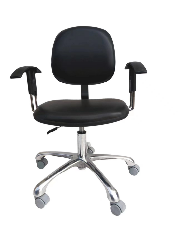
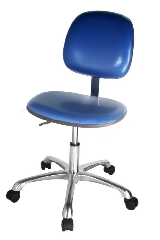
A practical ESD chair should allow buyers to confirm the key requirements quickly. The following specifications are important for most industrial and laboratory applications:
|
Item |
Recommended Specification |
Why It Matters |
|
Surface resistivity |
10^5–10^9 Ω |
A common static-dissipative range for electronics workshops, laboratories and EPA areas. |
|
Height adjustable |
420–560mm |
Covers most standard workbenches and seated operating positions. |
|
Seat base dimension |
480 × 400mm |
Balances seating support and workstation space efficiency. |
|
Back rest dimension |
400 × 360mm |
Provides essential back support for daily production, inspection and repair tasks. |
|
Configuration |
With armrests / without armrest |
Matches different work habits, workspace conditions and sitting durations. |
|
Color |
Black / Blue |
Standard industrial colors for electronics workshops and laboratories. |
|
Baseplate |
Rebound function |
Supports stable daily use in high-frequency work environments. |
3. Why These Two Standard ESD Chair Models Cover Most Daily Applications
There are many styles of ESD chairs, but in real purchasing scenarios, buyers usually need a clear and reliable standard option first. A 420–560mm height adjustment range fits many common workbench heights. A 480 × 400mm seat and 400 × 360mm backrest meet typical seated operation requirements. Surface resistivity of 10^5–10^9 Ω addresses the key static-control concern.
Standard models also make procurement easier. The specifications are clear, quotation and confirmation are faster, batch purchasing is more efficient, and repeat orders are easier to manage. For customers building or expanding EPA workstations, a standard ESD chair is often the most stable starting point.
4. ESD Chair Without Armrest: Flexible Choice for Active Workstations
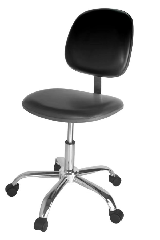
The ESD chair without armrest is suitable for workstations where operators need to move frequently, turn around or work close to the bench. Typical applications include SMT lines, PCB assembly, electronics assembly, packing inspection and compact work areas.
Without armrests, the chair gives operators more freedom of movement and reduces interference with hand operation. It is not simply a lower-level option; it is a practical configuration for active, high-frequency and space-limited workstations.
5. ESD Chair With Armrests: Better Support for Longer Sitting Tasks
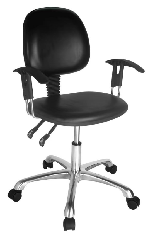
The ESD chair with armrests is better suited for longer sitting tasks, testing workstations, repair areas, laboratories and quality-control departments. Armrests provide additional support for the arms and shoulders, helping reduce fatigue during extended seated work.
When the workstation has enough space and the operator needs a stable sitting posture for inspection, repair or laboratory work, the model with armrests can offer better comfort and ergonomic support.
6. Black or Blue: Choosing the Right Color for Your Workplace
Black ESD chairs are practical for production lines, repair areas and industrial workshops because they are more resistant to visible dirt from daily use. Blue ESD chairs create a cleaner and brighter visual impression, making them suitable for laboratories, inspection areas and electronics assembly zones.
Both colors are standard choices for industrial buyers. They support batch purchasing, consistent workplace management and easier repeat orders.
7. When Should You Consider Other ESD Chair Styles?
The two standard models can cover most common applications, but different workplaces may have different workbench heights, cleanroom requirements, flooring conditions or operating habits. Some customers may need different seat materials, higher working heights, casters or glides, PU seats, stools, cleanroom-compatible models, special colors or other ESD seating solutions.
This is also the value of starting with standard models. Buyers can quickly confirm whether the basic requirements are matched. If the application is more specific, the selection can then be expanded to other models and configurations for a more complete long-term ESD product solution.
8. Conclusion: Start with a Proven Standard ESD Chair
For electronics workshops, PCB assembly areas, laboratories and EPA workstations, a reliable ESD chair should provide stable static-control performance, suitable dimensions, simple configuration choices and repeatable purchasing value. The model without armrest is ideal for flexible, high-frequency and compact workstations, while the model with armrests is better for longer sitting tasks, testing, repair and laboratory use.
When buyers need a fast and practical way to confirm specifications, color and configuration, these two standard ESD chairs can meet most common requirements. When other styles or special models are needed, the selection can be further expanded based on the actual working environment.
Company Information
Email: info@yufapolymer.com
Web: www.yufapolymer.com
Location: Shenzhen, China