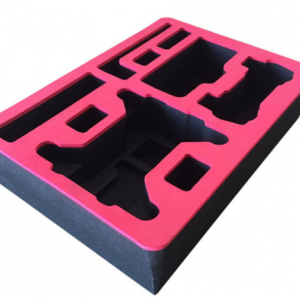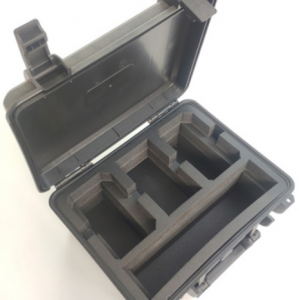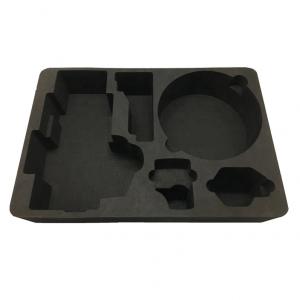

For sensor packaging trays, ESD performance is not the only requirement. Cleanliness, particle contamination risk, volume resistivity, long-term stability, and material compatibility are equally important.
|
Keywords |
ESD PP, IDP, polymer antistatic additive, carbon-black ESD, sensor tray, thermoformed tray, surface resistance, volume resistivity |
|
Core Conclusion |
For sensor packaging, IDP additive-based ESD PP generally offers advantages in cleanliness, non-coating structure, particle control, and material appearance. Carbon-black systems remain strong in cost, conductive stability, and process maturity. |
1. Why Sensor Trays Require More Than “Anti-Static” Performance
In electronic component and sensor packaging, an ESD tray does more than release static electricity. It also protects products from contamination, scratches, particles, and chemical residues. For sensors, packaging materials with carbon transfer, coating wear, extractables, or particle contamination may affect reliability, visual inspection, or downstream assembly. Therefore, a suitable ESD tray for sensors should normally consider the following factors:
· Whether the surface resistance is stable and controllable;
· Whether the volume resistivity also meets ESD requirements;
· Whether the material itself provides long-term or permanent ESD performance instead of relying on a surface coating;
· Whether surface cleanliness, particle release, and contamination risks are controlled;
· Whether the material is suitable for thermoforming, stacking, transport, and automated handling.
2. Principle of Carbon-Black-Filled ESD PP
Traditional ESD PP is often achieved by adding conductive carbon black. The core principle is the formation of a conductive network, also known as the percolation effect. When the carbon black loading reaches a certain level, the particles connect with each other inside the PP matrix, forming continuous or semi-continuous conductive pathways. As a result, both surface resistance and volume resistivity decrease.
This solution is mature, stable, relatively cost-effective, and usually less dependent on ambient humidity. Therefore, it is widely used in general electronic packaging, handling trays, and ESD trays.
However, carbon-black systems also have limitations. With higher carbon black content, the material is usually limited to black or dark colors. There may also be risks of carbon transfer, friction transfer, or particle contamination. In addition, high filler loading may affect PP toughness, the forming window, and fine-detail replication. These factors should be carefully evaluated for sensor packaging where cleanliness is more critical.
3. Principle of IDP Additive-Based ESD PP
IDP is commonly understood as an Inherently Dissipative Polymer, or a polymer-based antistatic system. It is different from conventional low-molecular antistatic agents and also different from carbon-black systems that rely on a particle-based conductive network. IDP helps form a dissipative phase within PP, allowing electric charge to be released in a more controlled and moderate way.
For thermoformed ESD PP trays, the key value of IDP additive-based material is that ESD performance comes from the material itself rather than from a surface coating. At the same time, it does not need to rely on a large amount of conductive carbon black particles to form a conductive network. For sensor trays, this means lower potential surface contamination risk, better cleanliness potential, and a material concept more suitable for precision electronic packaging.
For sensor thermoformed trays, the target ESD range for IDP additive-based material can typically be set as: surface resistance of 10^5–10^9 Ω and volume resistivity of 10^5–10^9 Ω·cm.
4. Core Comparison Between the Two Solutions
|
Comparison Item |
Carbon-Black-Filled ESD PP |
IDP Additive-Based ESD PP |
|
ESD Mechanism |
Forms a conductive / dissipative network through conductive carbon black particles |
Releases charge through a polymer dissipative phase |
|
Surface Resistance |
Easier to achieve a stable range |
Can reach 10^5–10^9 Ω; should be validated by test data |
|
Volume Resistivity |
Relatively easy to achieve through a carbon black network |
Can reach 10^5–10^9 Ω·cm; test standard and conditions should be confirmed |
|
Color Options |
Usually limited to black or dark colors |
Theoretically available in light colors or customized colors, but the electronics industry has long associated black with ESD packaging, making it easier for customers to identify |
|
Cleanliness |
May involve carbon dust / particle / friction transfer risk |
Usually cleaner and more suitable for sensor trays |
|
Coating Risk |
Non-coating system; no coating peeling risk |
Non-coating system; no coating peeling risk |
|
Humidity Dependence |
Usually lower |
Depends on the IDP system; high-end permanent types are more stable |
|
Cost |
Usually lower |
Usually higher |
|
Typical Applications |
General electronic packaging and ESD handling trays |
Sensors, precision electronics, and packaging trays requiring higher cleanliness |
5. Why IDP Is More Suitable for Sensor Thermoformed Trays
5.1 Lower Risk of Particle Contamination and Carbon Transfer
Sensor products are often sensitive to surface contamination. Traditional carbon-black systems can provide good ESD performance, but carbon black particles or surface micro-particles still need to be considered during friction, stacking, handling, and transport. IDP additive-based systems do not rely on a large carbon-black conductive network, making them more suitable for sensor trays where cleanliness is important.
5.2 ESD Performance Comes From the Material Itself, Not a Surface Coating
Surface-coated ESD trays may face coating wear, peeling, contamination, and performance decay. IDP additive-based ESD PP is an internally modified material system. Its ESD performance comes from the material body, making it more suitable for packaging trays that require long-term use, stacking, and transportation.
5.3 Both Surface Resistance and Volume Resistivity Can Be Designed
For sensor trays, declaring surface resistance alone is not sufficient. The volume resistivity of IDP additive-based material can also be controlled within the range of 10^5–10^9 Ω·cm, indicating that the material is not only dissipative on the surface, but that the overall material system also has electrostatic dissipative properties.
5.4 A More Appropriate “Controlled Dissipation” Concept for Precision Electronics
Sensor packaging usually does not require a highly conductive material. Instead, it requires static electricity to be released within a safe and controlled range. Static dissipative materials can prevent charge accumulation while reducing potential risks associated with overly conductive materials in contact applications.
6. Conclusion
For general electronic packaging, carbon-black-filled ESD PP remains a mature and economical solution. However, for sensors and other products that place greater emphasis on cleanliness, particle control, and material compatibility, IDP additive-based ESD PP provides a more valuable technical path.
If the material system uses an IDP additive-based approach to achieve electrostatic dissipation and can maintain both surface resistance of 10^5–10^9 Ω and volume resistivity of 10^5–10^9 Ω·cm, it can be considered a high-end ESD material option for sensor thermoformed trays.
Ultimately, the material selection for sensor trays should not be based on unit price alone. It should comprehensively evaluate ESD performance, cleanliness, particle risk, material stability, thermoforming feasibility, and long-term supply consistency.