
For thin-gauge thermoformed trays (sheet thickness ≤ 2mm), rib reinforcement design offers a smarter path to higher load capacity without increasing material cost.
|
Keywords |
thin-gauge thermoformed tray, rib reinforcement, structural efficiency, permanent anti-static PS tray, load capacity, material optimization |
|
Core Conclusion |
Through “small ribs, dense distribution” design, a 0.5mm thin-gauge tray can achieve 2–5× the load capacity of an unreinforced flat panel with only 10–20% material increase. Rib reinforcement is the most cost-effective way to improve structural performance. |
1. Why Thin-Gauge Thermoformed Trays Are the Future of Cost-Effective Packaging
In logistics and packaging, balancing cost with structural performance is a constant challenge. Thin-gauge thermoformed trays (sheet thickness no more than 2mm) have gained widespread adoption in electronics, food, pharmaceuticals, and other industries due to their natural advantages: minimal material usage, low cost, and lightweight construction.
However, “thin” also raises an intuitive concern: how to ensure sufficient load-bearing capacity? The first instinct is often to increase thickness. But for thin-gauge thermoforming, every 0.1mm increase in sheet thickness leads to a linear rise in material costs, along with increased forming difficulty. In fact, through proper rib reinforcement design, a 0.5mm tray can fully match or even exceed the load capacity of a 1.5mm unreinforced flat panel—this is the power of structural efficiency.
2. Three Core Advantages of Thin-Gauge Thermoformed Trays
Thin-gauge thermoformed trays offer three distinct advantages that make them increasingly competitive against thick-gauge and injection-molded alternatives:
2.1 Minimal Material Usage
Sheet thickness typically ranges from 0.2–2.0mm. Compared to thick-gauge blister packaging (3–8mm) and injection-molded trays (wall thickness >3mm), material usage can be reduced by 60–90%. For a standard 1200mm × 1000mm tray:
• 0.5mm thin-gauge tray: approx. 0.8–1.2 kg per unit
• 2.0mm thick-gauge tray: approx. 3.0–4.5 kg per unit
• Injection-molded tray: approx. 8–15 kg per unit
2.2 Low Cost
Thin-gauge thermoforming molds typically use aluminum or resin molds, with mold costs only 1/10 to 1/20 of injection molds. This advantage is especially significant for small to medium batch orders. Meanwhile, forming cycles are short (typically 15–60 seconds per mold) with low energy consumption, further reducing per-unit production costs. Overall, per-unit pricing is typically 1/5 to 1/3 of injection-molded trays.
2.3 Thin Yet Strong
“Thin” does not inherently mean “weak.” Through scientific rib reinforcement design, thin-gauge trays can achieve significant load capacity improvements with minimal material increase. The core principle: ribs distribute material away from the neutral axis, greatly improving the equivalent moment of inertia of the cross-section. This is similar to the I-beam principle in construction—concentrating material in the flanges rather than the web to achieve lightweight, high-strength structural performance.
3. Rib Reinforcement: The Structural Code of Thin-Gauge Trays
3.1 Mechanical Principle
Load-bearing capacity depends primarily on the moment of inertia (I) of the cross-section. For a rectangular cross-section:
I = b × h³ / 12
Although h affects I to the third power, the thickness direction space in thin-gauge trays is extremely limited (0.2–2mm). Rib reinforcement works by “pushing” material away from the neutral axis. According to I = Σ Aᵢ × dᵢ², the further the material from the neutral axis, the greater its contribution. A 1.5mm rib’s contribution far exceeds increasing wall thickness from 0.5mm to 1.0mm.
3.2 Rib Reinforcement vs. Thickness Increase
|
Comparison |
Increasing Thickness |
Rib Reinforcement |
|
Material Increase |
Wall 0.5→1.0mm = +100% |
1.5mm ribs = +10–20% |
|
Load Improvement |
Approx. 20–30% |
Up to 2–5× |
|
Forming Impact |
Extended cooling, higher difficulty |
Easy rib forming, no cycle impact |
|
Cost Impact |
Linear material cost increase |
Minimal cost increase |
3.3 Unique Strategy: “Small Ribs, Dense Distribution”
The rib strategy for thin-gauge trays differs fundamentally from thick-gauge. Since the sheet is thin (≤ 2mm) and elongation is limited, ribs should not be too deep or wide. The strategy is “small ribs, dense distribution”—individual rib height is small (typically 1–3mm), but quantity is high and spacing is dense, distributing loads through dense grid structures while compensating for limited single-rib strength.
4. Design Guidelines for Thin-Gauge Rib Reinforcement
4.1 Rib Layout
• Grid Ribs (Most Recommended): Cross-intersecting dense grid, uniform stress in all directions. Approx. 8–12 rows transverse, 12–20 columns longitudinal.
• Parallel Ribs: Along main stress direction. High material efficiency but weaker transverse rigidity.
• Border + Internal Grid: Higher border ribs as main frame, dense small ribs inside. Best for medium to large trays.
4.2 Key Parameters
|
Parameter |
Range |
Typical |
Notes |
|
Rib Height |
1–3mm |
1.5–2mm |
2–4× wall thickness |
|
Rib Width |
0.6–1.5mm |
0.8–1.2mm |
0.6–0.8× rib height |
|
Rib Spacing |
5–15mm |
8–10mm |
Dense to compensate single rib |
|
Root Radius |
R ≥ 0.3mm |
R 0.5mm |
Prevent stress concentration |
|
Draft Angle |
0.5°–1.5° |
1° |
Ensure smooth demolding |
4.3 Rib Position Selection
• Bottom Surface (Most Critical): Directly bears cargo load. Layout determines overall capacity.
• Border Areas: Slightly higher border ribs as main load-bearing frame.
• Fork Entry Areas: Densify ribs at forklift/hydraulic truck entry points for local impact resistance.
• Corner Areas: Prioritize reinforcement at stress concentration points.
4.4 Process Considerations
• Rib Direction: Parallel to material stretch direction to avoid excessive thinning at rib tops.
• Radius Transition: Root R ≥ 0.3mm to prevent stress concentration; small radius at top for demolding.
• Forming Depth: For 0.5mm sheet, rib depth should not exceed 2mm (rib top wall may drop below 0.2mm).
• Vacuum Holes: Avoid rib root areas to ensure proper forming.
5. Case Study: Permanent Anti-Static PS Thin-Gauge Tray
The image below shows a typical industrial thin-gauge thermoformed tray. This tray is formed from white permanent anti-static PS sheet material, with sheet thickness approximately 0.8–1.2mm. The overall shape is rectangular with rounded corners. The bottom surface is covered with dense cross-intersecting grid ribs—a classic application of the “small ribs, dense distribution” strategy.
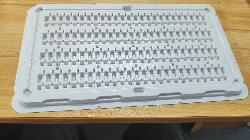
Figure 1 Typical industrial thin-gauge thermoformed tray with dense grid rib reinforcement
5.1 Structure Analysis
• Rib Layout: Cross-intersecting grid, approx. 8–9 rows transverse, 16–17 columns longitudinal. High-density grid ensures uniform stress and good overall rigidity.
• Rib Cross-section: Trapezoidal profile—wider at top to distribute pressure, narrower at bottom to save material. Each intersection has thickened “cross-shaped” reinforcement nodes.
• Border Reinforcement: Thickened perimeter borders (approx. 1–2cm high) serve as main load-bearing frame. Bottom edge extends into a “skirt” for forklift access.
• Lightweight Effect: Hollow grid cells reduce material and weight. Open structure allows ventilation and drainage.
• Functional Details: Handle holes on long sides (4 total), oval openings at short ends for lifting/stacking.
5.2 Design Advantages Summary
|
Advantage |
Performance |
|
Minimal Material |
Sheet thickness 0.8–1.2mm, approx. 1–1.5 kg/unit, only 1/8 of injection-molded trays |
|
Low Cost |
Low aluminum mold cost, short forming cycle, per-unit price 1/5 to 1/3 of injection trays |
|
Strong Load Capacity |
Dense grid ribs + border reinforcement far exceed same-thickness unreinforced panels |
|
Complete Functionality |
Handle holes, fork entry, stacking positioning—meets diverse use scenarios |
6. Conclusion
The core competitiveness of thin-gauge thermoformed trays lies in achieving maximum structural efficiency with minimum material. The ≤ 2mm sheet thickness limitation is not a performance ceiling—it is a constraint that drives design innovation.
Through the “small ribs, dense distribution” strategy, thin-gauge trays achieve 2–5× load improvement with only 10–20% material increase. The essence: place material as far as possible from the neutral axis to maximize rigidity and strength at minimal cost—the core principle of thin-walled structure design.
For enterprises, mastering these design methods means significantly improving product performance and market competitiveness without significantly increasing costs. Minimal material, low cost, thin yet strong—these are not only technical characteristics, but the core driving force for continued market expansion in modern logistics packaging.
Ultimately, the design of thin-gauge thermoformed trays should not focus on increasing thickness or material usage. It should comprehensively optimize rib layout, dimensional parameters, forming feasibility, and long-term structural reliability.