
YUFA POLYMER · Technical Blog
1. Why Are Industrial Aluminum Foil Bags Irreplaceable?
In the production and logistics chains of industries such as chemicals, pharmaceuticals, food, and advanced materials, packaging for powders and pellets may appear straightforward, yet it demands rigorous performance in barrier protection, mechanical strength, and seal integrity. When packaging falls short, the consequences range from product moisture absorption and caking to oxidation and degradation — or worse, compromised quality across entire shipments and eroded customer trust.
Among all packaging solutions, the Industrial Aluminum Foil Bag stands out as the preferred choice for high-protection scenarios, owing to its uniquely engineered multi-layer composite structure. Its irreplaceability is rooted in three core dimensions:
1.1 Superior Barrier Performance
The aluminum foil layer (AL), as a metallic barrier material, achieves near-100% blocking rates for water vapor and oxygen at ambient temperature. By contrast, the barrier performance of pure plastic films (such as PE bags or PP woven bags) is orders of magnitude lower. For highly hygroscopic powder materials (e.g., PHA polymer powders, chemical raw materials) or oxygen-sensitive products, aluminum foil bags represent one of the most cost-effective protection solutions available today.
1.2 Excellent Mechanical Protection
The polyamide (PA/nylon) layer within the multi-layer composite provides outstanding puncture resistance and tear strength. Pelletized materials generate internal friction and impact forces during transit, exerting continuous stress on the bag's inner wall. The four-layer structure of aluminum foil bags effectively resists these mechanical threats, eliminating the risk of bag failure.
1.3 Complete Seal Integrity
Aluminum foil bags deliver excellent heat-sealing performance. The PE inner layer forms a robust seal upon heating, ensuring that the bag maintains its integrity under extreme conditions such as long-distance transportation and high-temperature storage. For industrial products requiring long-term storage or cross-border shipping, seal integrity is the final line of defense for product quality assurance.
2. Anatomy of a Foil Bag: The PE/AL/PA/PET Four-Layer Structure
An industrial aluminum foil bag is far more than a simple "foil + plastic bag." It is a precision-engineered multi-layer composite system. Taking our standard industrial aluminum foil bag as an example, the PE/AL/PA/PET four-layer structure assigns each layer a distinct role, working in concert to deliver barrier protection, mechanical strength, and reliable sealing.
2.1 PET Layer (Outer) — Structural Backbone & Print Surface
Material: Polyester film (PET), typical thickness: 10–15μm
· Provides overall rigidity and dimensional stability
· Surface suitable for high-quality printing: branding, product information, barcodes
· Excellent heat resistance, withstands outer-layer temperatures during heat sealing
· Outermost layer offers abrasion and scratch protection
2.2 PA Layer (Nylon) — The Toughness Guardian
Material: Polyamide film (Nylon), typical thickness: 15–25μm
· Exceptional puncture resistance, protecting the aluminum foil layer from sharp internal particles
· Superior flexibility — bag resists cracking under folding, compression, and drops
· Wide temperature range (−40°C to 150°C), suitable for cold chain and high-temperature storage
· Excellent tear propagation resistance — minor damage does not expand easily
2.3 AL Layer (Aluminum Foil) — The Barrier Core
Material: High-purity aluminum foil, typical thickness: 7–9μm
· Near-100% water vapor and moisture barrier — unmatched by plastic films
· Complete oxygen barrier, preventing product oxidation, degradation, or spoilage
· 100% light blocking, protecting photosensitive materials
· Odor barrier, preventing external odor ingress or internal odor escape
*Note: The integrity of the aluminum foil layer is the key to the bag's barrier performance. Foil that is too thin is prone to pinholes, compromising barrier effectiveness; foil that is too thick reduces the bag's flexibility. The 7–9μm range is a well-established balance, validated through long-term industrial use.
2.4 PE Layer (Inner) — Sealing & Compatibility
Material: Polyethylene film (PE), typical thickness: 50–80μm — the thickest of the four layers
· Heat-seal layer: achieves reliable sealing at 150–180°C
· Chemically inert: compatible with the vast majority of chemicals, food, and pharmaceutical materials
· Smooth inner surface facilitates filling and pouring
· PE with different melt flow indices (MFI) can be selected to adjust sealing temperature and bond strength
2.5 How the Four Layers Work Together
Outer PET layer absorbs printing and external wear → PA layer absorbs impact and puncture forces, protecting the foil → AL layer delivers the core barrier → PE layer completes the heat seal and contacts the product directly. All four layers are indispensable — the absence or reduction of any single layer will significantly degrade overall performance.
3. The Secret Behind Thickness: Selection Logic from 16c to 23.5c
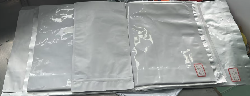
In quotations and technical specifications for industrial aluminum foil bags, you will frequently encounter parameters such as "16c," "17c," "20c," and "23.5c." The "c" here is a widely used industry thickness unit:
1c = 0.01mm = 10μm
Therefore, 17c indicates a total bag thickness of 0.17mm (170μm), and 23.5c indicates 0.235mm (235μm). Higher total thickness delivers stronger overall protection, but at increased cost and weight.
3.1 Thickness Grade Comparison
|
Thickness |
Actual Thickness |
Typical Applications |
Protection Level |
|
16c |
0.16mm |
Lightweight powders, dry pellets, short-distance transport |
Standard |
|
17c |
0.17mm |
Electronic components, general chemical raw materials |
Standard |
|
18c |
0.18mm |
Medium-weight pellets, food-grade materials |
Moderate |
|
20c |
0.20mm |
Heavy pellets, hygroscopic powders, long-distance transport |
High |
|
23.5c |
0.235mm |
Heavy-duty materials, highly sensitive materials, ocean freight export |
Maximum |
3.2 Key Considerations for Thickness Selection
· Product weight: Heavier fill weights demand greater mechanical strength — recommend 20c or above
· Material sensitivity: Materials highly sensitive to moisture and oxygen (e.g., PHA polymers, lithium battery raw materials) require ≥20c
· Transport distance: Cross-border ocean freight involves extended transit times and complex conditions — higher thickness is advisable
· Storage conditions: High-temperature, high-humidity environments require thicker bags for sustained protection
· Cost balance: Choose the most economical thickness that meets protection requirements — avoid over-packaging
4. Four Evaluation Dimensions: How to Systematically Test Foil Bags
Once you have identified candidate bag specifications, we recommend conducting a systematic sample evaluation before placing a formal order. The following four evaluation dimensions are the most critical in the aluminum foil bag selection process:
4.1 Filling Performance
Filling performance assesses how the bag behaves during actual filling operations:
· Bag opening: Does the bag open naturally, facilitating equipment or manual filling?
· Bottom stability: Can the empty bag stand upright without tipping during filling?
· Filling efficiency: Does the bag design promote rapid, uniform material filling?
· Dust control: Does the bag opening effectively limit dust escape during filling?
Recommendation: For powder products, consider bags with side gussets (gusseted bags), which expand more fully during filling, improving efficiency. For pellet products, standard flat bags or stand-up pouches are generally sufficient.
4.2 Heat Sealing Performance
Heat sealing performance directly determines packaging seal reliability — one of the most critical aspects of foil bag evaluation:
· Sealing temperature range: The PE inner layer typically achieves effective sealing at 150–180°C, varying by PE formulation
· Sealing pressure and dwell time: Adjust parameters based on bag thickness — thicker bags require higher pressure and longer sealing times
· Seal strength: Conduct peel tests after sealing to ensure bond strength matches or exceeds bag body strength
· Seal appearance: A proper seal should be flat, free of bubbles, wrinkles, or burn-through
Recommendation: For initial testing, heat-seal samples at different temperature steps (e.g., 150°C, 160°C, 170°C, 180°C) to identify the optimal parameter combination before proceeding to batch trials. Your supplier should be able to provide recommended sealing parameter ranges.
4.3 Handling Performance
Handling performance evaluates the bag's behavior across filling, transport, stacking, and other real-world operational stages:
· Grip and carrying experience when fully loaded: Is the bag surface easy to grip? Does it feature anti-slip design?
· Stacking stability: Can loaded bags be stably stacked without sliding or toppling?
· Drop resistance: Simulate accidental drops during handling — does the bag rupture or the seal split?
· Manual vs. automated line compatibility: Are the bag's size and rigidity suitable for manual handling, or compatible with automated filling and sealing equipment?
Recommendation: If your production process involves automated filling lines, test bag feeding smoothness, positioning accuracy, and sealing consistency on the automated equipment during the sample stage. Manual and automated packaging have different requirements for bag opening design and rigidity — be sure to communicate your packaging method to the supplier for targeted recommendations.
4.4 Storage Performance
Storage performance focuses on the long-term stability of packaged products during warehousing:
· Barrier durability: Can the bag maintain effective barrier protection over 6 months, 12 months, or longer under target temperature and humidity conditions?
· Temperature tolerance: Can it withstand temperature fluctuations in storage (e.g., high-temperature warehouses, cold chain environments)?
· Compression strength: During stacked storage, can bottom-layer bags bear the weight of upper layers without deformation or rupture?
· Shelf-life alignment: Does the bag's protection level match the product's shelf-life requirements?
Recommendation: For products requiring long-term storage or ocean freight, conduct accelerated aging tests during the sample stage — simulating high-temperature, high-humidity conditions to evaluate the bag's barrier performance and mechanical integrity under extreme conditions.
5. Size Selection Guide: Capacity vs. Dimensions
Selecting the right bag capacity requires careful consideration of material bulk density, single-batch fill quantity, and warehouse space utilization. The following table provides reference guidelines for common capacity ranges and recommended bag types (exact dimensions must be confirmed based on actual material density and supplier tooling):
|
Target Capacity |
Recommended Bag Type |
Reference Size Range |
Application Scenarios |
|
5–10L |
Flat bag / small gusset bag |
W 250–350mm, H 400–600mm |
Small-batch samples, high-value materials |
|
10–20L |
Medium gusset bag |
W 300–380mm, H 500–700mm |
Medium batches, lab materials |
|
20–30L |
Large gusset bag |
W 350–420mm, H 550–750mm |
Standard production packaging |
|
30–40L |
Extra-large gusset bag |
W 380–450mm, H 650–850mm |
Bulk shipments, medium orders |
|
40–50L |
Super-large gusset bag |
W 400–500mm, H 700–1000mm |
Large-volume shipments, export packaging |
|
50L+ |
Custom dimensions |
Per requirements |
Special specifications, industrial bulk |
*Note: The above are reference ranges. Actual dimensions must be determined based on material bulk density, per-bag fill weight, and pallet/carton matching requirements. YUFA POLYMER supports full-size customization and can provide optimal dimension recommendations based on your specific needs.
6. Common Mistakes to Avoid
Mistake #1: Choosing on Price Alone, Ignoring Thickness Match
Selecting a thickness specification below actual requirements is the most common error. While thinner bags have a lower unit price, the losses from inadequate protection — moisture absorption, oxidation, or bag rupture — far exceed the packaging cost difference. The correct approach is to first determine the minimum thickness requirement based on material characteristics and transport conditions, then compare prices within that range.
Mistake #2: Overlooking Aluminum Foil Layer Quality
Some suppliers cut corners on the aluminum foil layer — using foil that is too thin or contains pinholes. Visually, these bags appear identical to standard ones, but their barrier performance is significantly compromised. We recommend that purchasers conduct a simple light-transmission test during sample evaluation: hold the bag up to a light source — a qualified aluminum foil bag should be completely opaque.
Mistake #3: Not Considering Packaging Method Compatibility
Manual packaging and automated production lines have different bag requirements. Automated lines demand higher dimensional consistency and rigidity suited to machine gripping and positioning; manual packaging prioritizes easy bag opening and operational convenience. Be sure to communicate your packaging method to the supplier during selection for targeted recommendations.
Mistake #4: Applying a One-Size-Fits-All Heat Sealing Parameter
Aluminum foil bags with different thicknesses and material structures require different heat sealing parameters. Simply copying parameters from another product line can result in weak seals or overheating. Whenever switching specifications, it is recommended to re-test heat sealing parameters.
Mistake #5: Ignoring Storage and Transport Environments
The same aluminum foil bag may perform very differently in a climate-controlled dry warehouse versus a high-temperature, high-humidity shipping container. Selection must account for the most demanding transport and storage scenarios, not just ideal conditions.
7. Need Help with Selection? Our Team Is Here to Assist
Selecting the right industrial aluminum foil bag may seem straightforward, but it involves multiple technical dimensions: material structure, thickness matching, size design, and heat sealing parameters. Poor selection not only affects packaging efficiency but can also lead to product quality risks.
YUFA POLYMER specializes in the R&D and manufacturing of industrial aluminum foil bags, with extensive experience in multi-layer composite foil bag production. We support full-size customization from 5L to 50L and beyond, with thickness coverage from 16c to 23.5c, and provide professional technical support on material structure and heat sealing parameters.
If you have any questions during the aluminum foil bag selection process, please do not hesitate to contact the YUFA POLYMER technical team. We will quickly recommend the most suitable specification based on your product characteristics, packaging workflow, and transport conditions.
Email: info@yufapolymer.com
Website: www.yufapolymer.com