
Thick-block cutting, complex CNC cavities and long-term reusable packaging
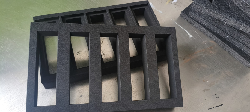
Custom-fabricated ESD EVA foam insert
When packaging requires a thick one-piece structure, stable support or deep custom cavities, ESD EVA is often one of the first materials to evaluate. The final decision should still be based on the product drawing, customer handling habits, quantity and budget.
|
Product Positioning Black ESD EVA is a closed-cell foam with Shore C 38±5 hardness and a density of 65±5 kg/m³. Length, width and thickness can be cut to order, with a maximum thickness of 50 mm. |
Core Point 1: Thick Blocks Reduce Unnecessary Lamination
EVA is foamed as a block, allowing sheet length, width and thickness to be cut for the project. For deep cavities or thick inserts, a one-piece thickness of up to 50 mm can reduce visible layer lines and lamination steps. ESD adhesive can be used when different structures must be assembled.
Core Point 2: Suitable for Complex and Deep CNC Cavities
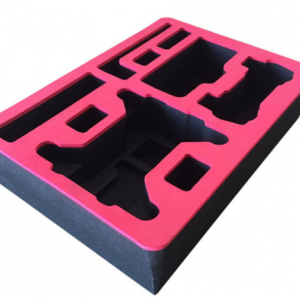
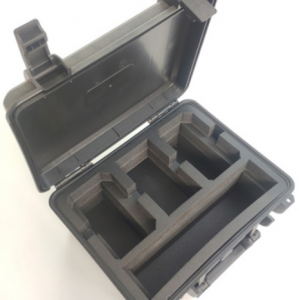
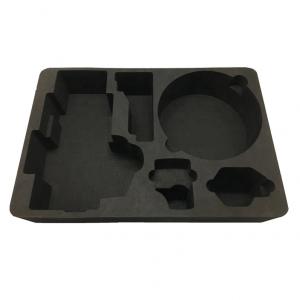
EVA can be cut, die-cut or CNC-machined into trays and inserts for PCB/PCBA assemblies, sensors, optical parts and precision equipment. Internal CNC corners are limited by cutter diameter, so corner radii, slot width and cavity depth should be confirmed during drawing review.
Core Point 3: Permanent ESD Performance
The ESD performance is provided by conductive carbon black compounded into the material rather than a surface coating. Surface resistance is 1.0×10⁵–1.0×10⁹ Ω and static decay is under 2.0 seconds, making the material suitable for long-term circulation and repeated handling.
Core Point 4: Support and Dimensional Stability
Its closed-cell structure, Shore C 38 hardness and relatively high density make EVA suitable for packaging that requires stable support. Volumetric water absorption is no more than 0.5%. For very light or thin packaging, or when reducing package weight is the priority, IXPE and EPE should also be compared.
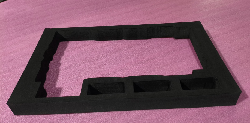
ESD EVA cavity and cut structure
Key Technical Data
|
Color and cell structure |
Black, closed-cell |
|
Density |
65±5 kg/m³ |
|
Hardness |
Shore C 38±5 |
|
Thickness |
Made to order; maximum 50 mm |
|
Surface resistance |
1.0×10⁵–1.0×10⁹ Ω |
|
Static decay |
< 2.0 seconds |
|
ESD service life |
Permanent |
|
Fabrication methods |
Cutting, die cutting, CNC machining and ESD-adhesive bonding |
Which Projects Should Consider EVA First?
• A thick one-piece insert or deep cavities are required
• The product is relatively heavy and requires stable support
• The product geometry is complex and requires CNC machining
• The packaging will be reused or handled repeatedly
• The project should minimize multi-layer thermal lamination
|
Solution Confirmation EVA is not the default choice for every project. While respecting the customer’s established operating habits, the Yufa team compares materials and fabrication methods based on drawings, protection requirements, quantity and budget. |
|
Need help with an ESD packaging project? Send us your product drawing and preferred foam material, or simply describe the application and approximate dimensions. Yufa can help develop a suitable solution. Yufa Polymer Products Co., Ltd. Email: info@yufapolymer.com | Website: www.yufapolymer.com |