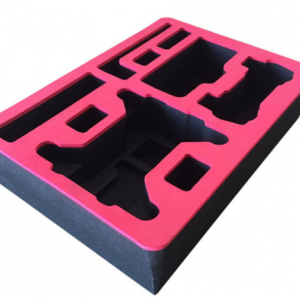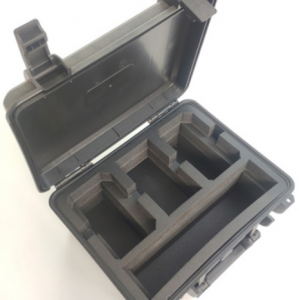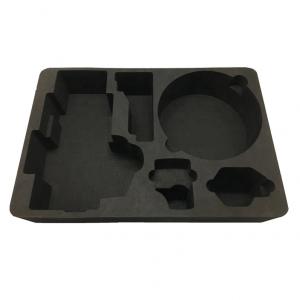

5 mm single layers, thermal lamination, die cutting and ESD service life
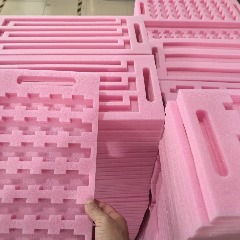
Finished multi-layer laminated pink ESD EPE product
Pink ESD EPE has a relatively low density and suits lightweight ESD packaging with straightforward structures and a defined service period. Its differences from EVA and IXPE extend beyond weight to thickness construction, fabrication method and ESD service life.
|
Product Positioning Pink ESD EPE is an open-cell/semi-closed-cell foam with a density of 28±3 kg/m³ and a standard single-layer thickness of 5±0.3 mm. |
Core Point 1: Lightweight
With a density of 28±3 kg/m³, EPE is suitable for projects that need to control package weight. It can be used for lightweight electronic components, trays, dividers and interleaving protection. The decision should still consider product weight, vulnerable areas and transport conditions.
Core Point 2: Greater Thickness Requires Multi-Layer Thermal Lamination
The standard single-layer thickness is 5±0.3 mm; a thicker finished part should not be interpreted as one foam layer. Greater thickness is achieved by thermally laminating multiple layers. Layer count affects accumulated tolerance, visible lamination lines, processing steps and finished price.
EPE is suitable for die-cut trays, dividers and pads. CNC milling is not recommended for complex cavities. When a drawing includes deep slots, complex steps or high-precision cavities, EVA or IXPE should also be evaluated.
Core Point 4: Six-Month ESD Service Life
EPE has a surface resistance of 1.0×10⁹–1.0×10¹¹ Ω and static decay of under 2.0 seconds. Its antistatic function is inherent to the material rather than a surface coating, but the TDS specifies an ESD service life of six months from manufacture. Purchasing should therefore be planned around production, inventory, shipping and the customer’s use cycle.
Core Point 5: Suitable for Short-Cycle, Lightweight Solutions
EPE suits short-cycle transport and simple die-cut structures. The material complies with RoHS and REACH, but no UL 94 or equivalent flammability rating has been established; it is a combustible solid. Projects with flame-retardancy requirements require separate confirmation.
Key Technical Data
|
Color and cell structure |
Pink, open-cell/semi-closed-cell |
|
Density |
28±3 kg/m³ |
|
Single-layer thickness |
5±0.3 mm |
|
Greater finished thickness |
Multi-layer thermal lamination |
|
Surface resistance |
1.0×10⁹–1.0×10¹¹ Ω |
|
Static decay |
< 2.0 seconds |
|
ESD service life |
6 months from manufacture |
|
Fabrication methods |
Die cutting and thermal lamination recommended; CNC milling not recommended |
Which Projects Should Consider EPE First?
• Lightweight packaging is a priority
• The product structure suits simple die cutting
• Trays, dividers or interleaving protection are required
• Production, shipping and use can remain within the specified service period
• The project has no confirmed flame-retardancy requirement
|
Solution Confirmation EPE layer count, ESD service life and die-cut structure should be confirmed against the customer’s actual operating process. The Yufa team determines whether EPE is the right finished solution based on the drawing, quantity, budget and transport requirements. |
|
Need help with an ESD packaging project? Send us your product drawing and preferred foam material, or simply describe the application and approximate dimensions. Yufa can help develop a suitable solution. Yufa Polymer Products Co., Ltd. Email: info@yufapolymer.com | Website: www.yufapolymer.com |